What Is Liveness Detection in Corrections?
What Is Liveness Detection in Corrections? A Plain Guide
How camera-based monitoring works, and how OptiGuard™ applies 4Sight Labs' own Liveness-Detection™ technology in a cell.
Most people who have heard the term "liveness detection" encountered it somewhere else entirely: unlocking a phone with a face scan, or verifying an identity for a bank app, where the goal is proving a real person, not a photo or a mask, is presenting themselves. That is a real and common use of the term, but it is not what liveness detection means inside a correctional facility.
In corrections, liveness detection refers to camera-based technology that continuously checks for signs of movement, presence, and activity in a monitored cell, so staff have an ongoing indication of well-being between physical checks, rather than technology that verifies someone's identity.
That distinction points to the actual problem liveness detection is built to solve. It doesn't replace the correctional officer or the physical check that officer is required to perform. It gives that officer more continuous information to work with in the time between checks, so a gap in well-being is less likely to go unnoticed until the next round.
This discussion focuses on operational supervision considerations in custodial environments and is not intended to provide clinical or medical guidance. Correctional healthcare decisions should always be directed by qualified medical professionals and applicable facility policy.
Where the Term Comes From, and Why Corrections Uses It Differently
Liveness detection originated in biometric security, where it addresses "presentation attacks," attempts to fool a face or fingerprint scanner with a photo, a mask, or a recording instead of an actual live person. Security researchers generally split detection methods into two categories: active methods, which require the person to do something, such as speak or move on command, and passive methods, which run in the background without requiring any specific action. (Source: 1Kosmos, Liveness Detection; see also NIST's overview of liveness and anti-spoofing evaluation.)
The underlying idea, using a camera to distinguish a real, live person from a static or artificial substitute, is the same. What's being verified is completely different.
A correctional application isn't authenticating anyone's identity. There's no login, no credential, and no attempt to match a face against a database. The question a correctional liveness-detection system answers is simpler and more operational: is there an indication of ongoing movement and presence in this cell, right now, that staff can rely on as a signal between physical checks?
How OptiGuard™ Applies In-Cell Liveness-Detection™ Technology
OptiGuard™, 4Sight Labs' camera-based in-cell monitoring platform, applies its own trademarked Liveness-Detection™ technology using a facility's camera feed to continuously assess a monitored cell for indicators of movement and presence. Rather than requiring staff to conduct and log a physical check to confirm that basic indication, OptiGuard's Liveness-Detection™ generates that signal automatically, on an ongoing basis, using cameras many facilities already have in place.
"Continuous" has a specific meaning here, and our technology is built for it. Rather than a single instant, OptiGuard™ runs this check on a short, fixed cycle, currently every 60 seconds, per cell. Over the span of a single physical-check interval, whether that's 15, 30, or 60 minutes depending on the governing state standard, that cycle produces dozens of independent observations instead of one. That's the practical difference continuous monitoring is meant to make: a gap in well-being has far less time to run before it's reflected somewhere staff can see it.
The system presents a darkened, silhouette-style view rather than raw video, showing movement and presence without exposing identifiable footage, and documents that activity automatically as part of the facility's observation record.
When that ongoing check turns up something worth attention, for example, an extended stretch without expected movement, OptiGuard™ surfaces a notification on the facility's dashboard, tied to the specific cell and housing unit and time-stamped to when it was generated, alongside the live status view for every other monitored cell. Facilities set their own notification thresholds rather than working from a single fixed default, so what actually triggers a notification reflects that facility's own protocols.
Liveness-Detection™ supplements the physical check; it does not replace the judgment a trained officer applies during that check.
Can Existing Jail Cameras Support It?
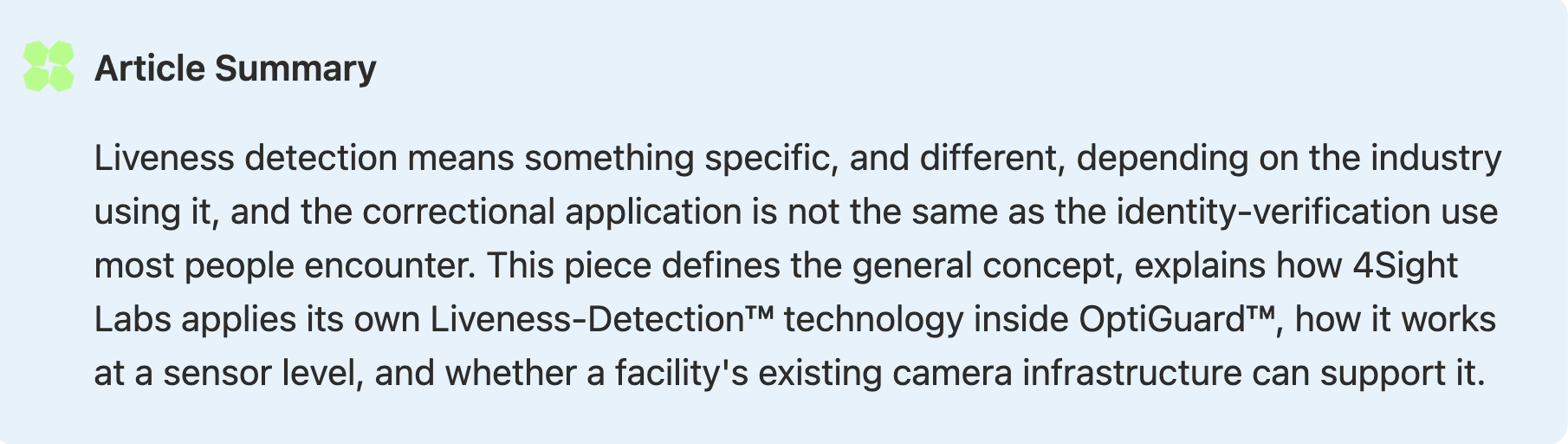
This is one of the most common procurement questions agencies ask, and the honest answer depends on the camera infrastructure already in place. OptiGuard™ is built to work with camera infrastructure many correctional facilities have already deployed, rather than requiring a full hardware replacement. Agencies evaluating this should confirm, with any vendor, the specific camera resolution, placement, and network requirements the software actually needs, since "works with existing cameras" can mean different things depending on how a given facility's system was originally installed.
What Camera-Based Monitoring Actually Detects
Camera-based liveness detection in a correctional setting is built to identify a narrow, specific set of indicators: whether movement is occurring, whether a monitored individual's position or activity has changed over a given window, and whether the absence of expected movement over time should prompt staff attention.
It is not built to, and should not be described as, diagnosing a medical condition, reading vital signs from video alone, or making a determination about someone's state of mind. Those are different technical problems, addressed by different technology, including 4Sight Labs' own wearable biometric platform, OverWatch®, which reads physiological signals such as heart rate and blood oxygen directly from a worn sensor rather than inferring them from a camera feed.
Questions to Ask Any Vendor About Camera-Based Monitoring
Agencies evaluating camera-based liveness detection technology should press on the specifics of how the system actually works, not just the marketing term. The following questions apply regardless of which platform a facility is considering.
1. Existing Infrastructure Compatibility
What specific camera resolution, placement, and network conditions does the software actually require to function reliably?
A general claim of working with "existing cameras" can obscure real hardware or network requirements a facility needs to plan for.
2. What Is Actually Being Detected
Is the system detecting movement and presence, or is it claiming to assess a medical or physiological condition from video alone?
These are different technical claims, and a vendor should be precise about which one it's actually making.
3. Privacy by Design
Does the system expose identifiable video, or does it present a privacy-preserving view such as a silhouette or motion indicator?
This affects both privacy policy and how comfortable staff and oversight bodies are with continuous camera-based monitoring.
4. Documentation Output
Does the system generate a time-stamped record automatically, and can that record be produced for inspection or review?
A detection capability that doesn't produce a usable record adds less documentation value than it should.
4Sight Labs built OptiGuard's Liveness-Detection™ technology around these same questions, not because they are unique to us, but because they are what agencies should ask about any camera-based monitoring claim, regardless of vendor.
What 4Sight Labs Does Not Claim
OptiGuard™ is engineered to strengthen situational awareness between physical checks. It is a support layer, not an autonomous decision-maker, and staff verification and judgment remain central to every response.
- Not diagnostic: Liveness-Detection™ is not intended for diagnosis or treatment of any medical condition.
- Not a clinical substitute: camera-based activity indicators are not a substitute for clinical evaluation by qualified medical personnel.
- Not a guarantee: no monitoring system can guarantee an outcome. Continuous awareness strengthens situational visibility between checks; it does not replace staff judgment, staffing levels, or training.
- Not autonomous: indicators direct staff attention; they do not act on their own or make a determination about an individual's condition.
Frequently Asked Questions
What does liveness detection mean in a correctional setting?
It refers to camera-based technology that continuously checks a monitored cell for indicators of movement and presence, giving staff an ongoing signal between physical checks. This is different from the identity-verification use of the same term in biometric security.
Is Liveness-Detection™ the same thing as facial recognition?
No. It does not attempt to identify or authenticate anyone. It assesses movement and presence within a cell using a camera feed, without matching a face to any database.
Can a facility's existing cameras support this technology?
Often yes, since platforms like OptiGuard™ are built to work with camera infrastructure many facilities already have. Agencies should confirm specific resolution, placement, and network requirements directly with any vendor before assuming compatibility.
Does camera-based liveness detection replace physical observation rounds?
No. It is designed to supplement the required physical check with continuous, documented awareness between rounds, not to replace the check or the staff judgment it requires.
Liveness detection means something specific and operational in a correctional context: continuous, camera-based awareness of movement and presence between physical checks, not identity verification. Understanding that distinction is the first step in evaluating whether the technology fits a facility's actual monitoring needs.
Correctional leaders seeking additional resources on monitoring technology can explore the 4Sight Labs Resource Center.