Correctional Monitoring System Uptime
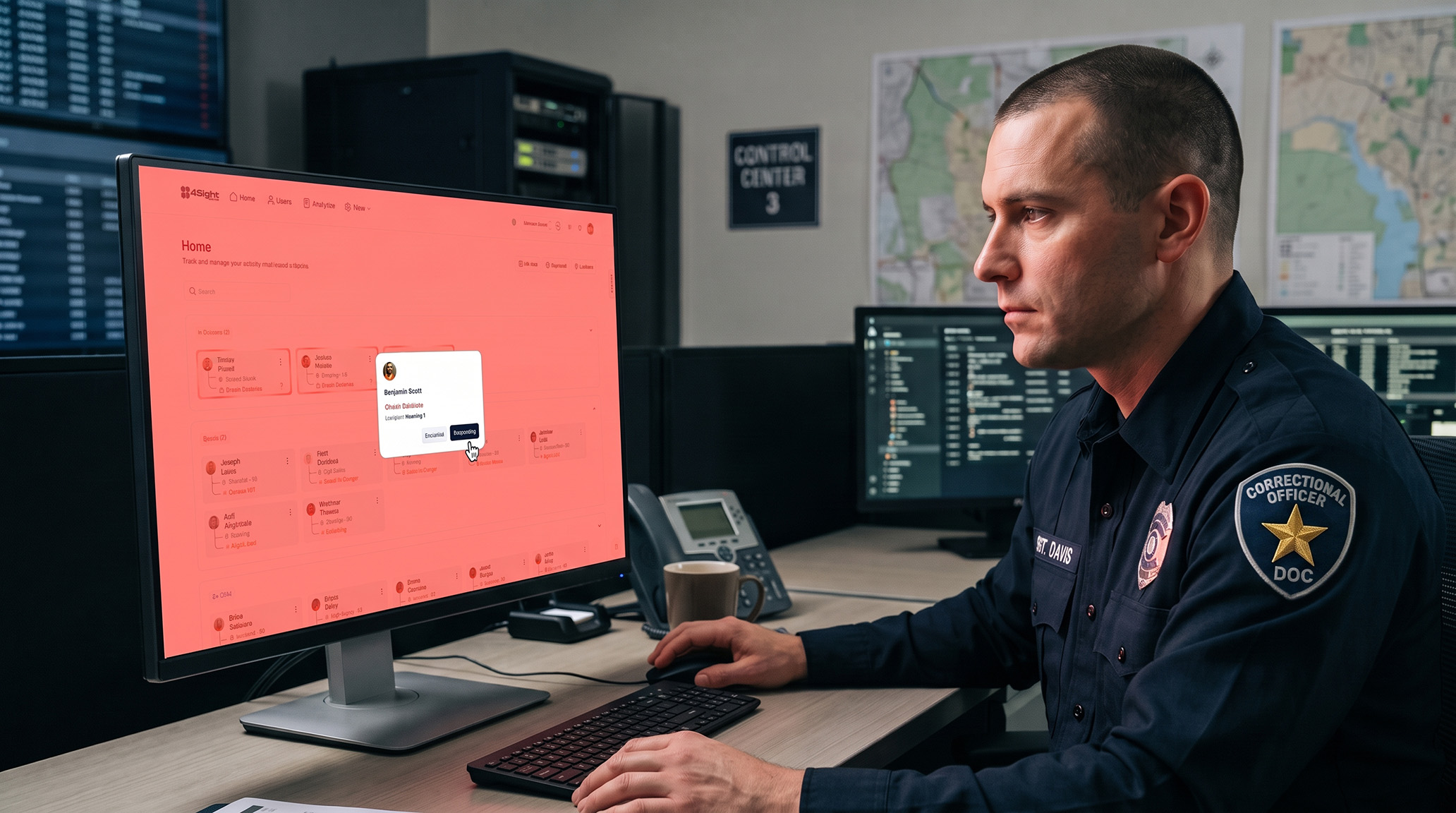
What 99.99% Actually Means for Facilities
Uptime percentages appear frequently in vendor materials, but a single figure rarely tells command staff what they actually need to know: whether staff will receive an alert when it matters, not just whether a server was technically online.
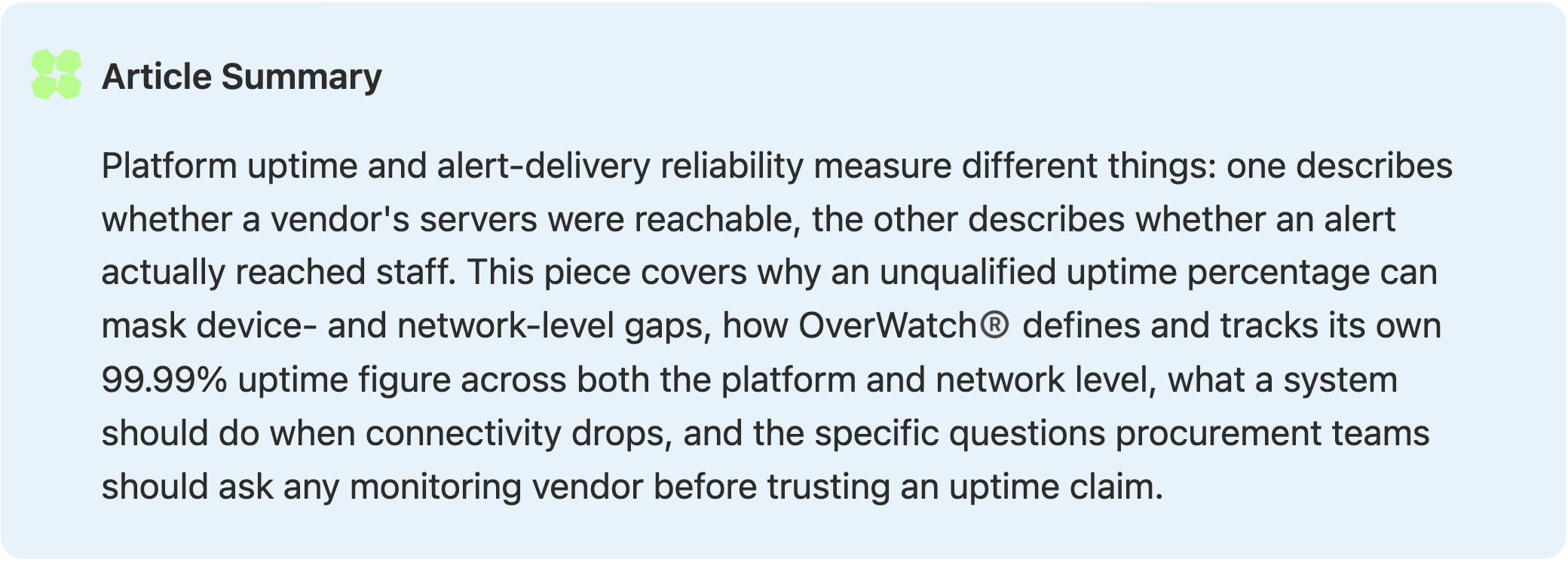
A correctional monitoring system is the combination of wearable sensors, facility wireless infrastructure, and cloud-hosted software that keeps staff continuously aware of individuals in custody.
How reliable that system actually is, in practice, comes down to a distinction procurement teams often overlook: platform uptime and alert-delivery reliability are not the same measurement.
This discussion focuses on operational and technical considerations in correctional monitoring deployments and is not intended to provide clinical, medical, or legal guidance. Correctional healthcare and procurement decisions should always be directed by qualified professionals and applicable facility policy.
Why a Single Uptime Number Doesn't Tell the Whole Story
A vendor advertising a high platform uptime percentage is describing how consistently its backend infrastructure remained operational, which is a meaningful figure, but an incomplete one until the vendor also defines what layer of the system that figure actually measures.
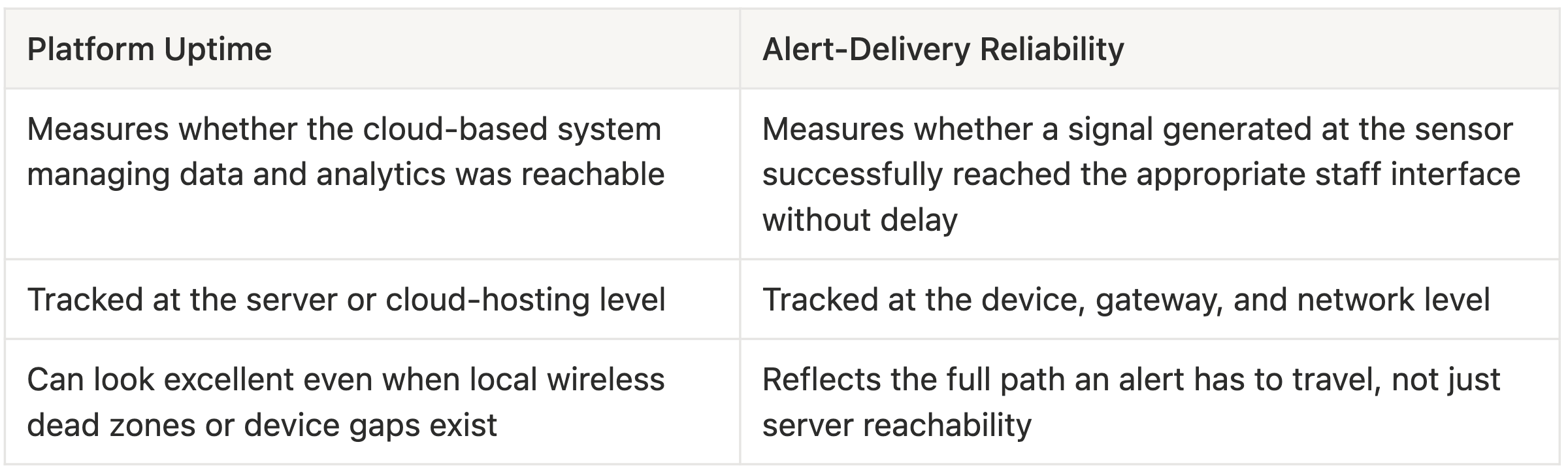
Uptime is typically measured at the server or cloud-hosting level, reflecting whether the platform itself was reachable, not whether every individual sensor, gateway, or alert successfully reached facility staff during that window.
A facility could technically experience excellent platform uptime while still encountering gaps in device connectivity, delayed alert delivery, or localized wireless dead zones that never register in the vendor's overall uptime calculation.
Procurement teams that accept an uptime figure without asking what it measures, and at what layer of the system, risk drawing false confidence from a number that describes cloud infrastructure reliability rather than the end-to-end reliability of alerts reaching a control room.
The distinction matters because the operational question is never "was the platform online" but "did staff receive the information they needed, when they needed it."
A precise, well-defined uptime figure is a useful data point. An undefined one is closer to a marketing claim.
Platform Uptime Isn't Alert-Delivery Reliability
Platform uptime and alert-delivery reliability are related but distinct measurements, and correctional procurement teams should evaluate both.
A system built on long-range wireless technology capable of penetrating steel and concrete construction, for example, is addressing a specific reliability challenge unique to correctional facilities, where dense building materials routinely disrupt standard wireless signals.
In practice, this is what allows a facility to run on a very light infrastructure footprint, often a single router per floor rather than a dense network of repeaters, which simplifies both installation and the failure points procurement teams need to evaluate. Vendors should be able to speak to both measurements separately and explain how each is tracked.
A platform with excellent server uptime but unreliable in-facility signal transmission has not solved the problem that matters most to a booking sergeant or shift supervisor: getting the alert to the right person in time to act on it.
For procurement teams, this is the single most important distinction to press vendors on before any contract is signed.
Built for Reliability at Every Layer
OverWatch® is engineered to stay reliable at every layer of the system, not just at the server. The platform is hosted on Microsoft Azure Government, a higher-security cloud environment built specifically for government and public-sector data, with documented redundancy and disaster recovery built in. It meets HIPAA hosting standards and is SOC 2 compliant, verified through independent third-party penetration testing. OverWatch® maintains 99.99% uptime across its deployed facility base, tracked at both the platform level and the network level, not just at the server.
If a single sensor or gateway loses connectivity, the platform flags the gap to staff directly. It does not fail silently. Because uptime is measured at both layers, that 99.99% figure reflects the full path an alert has to travel, not just whether a server was reachable.
Wearable components are also built for endurance. A 14-day battery life means devices rarely go offline from depletion, closing one of the most common blind spots in correctional monitoring. Because the sensors monitor continuously rather than cycling on and off like consumable devices, physiological signals are captured at the millisecond level, not sampled at intervals.
Redundant hosting, transparent failure reporting, and long battery life together are what turn an uptime number into a claim procurement teams can actually verify.
What Happens When Connectivity Drops
Every wireless monitoring system will, at some point, experience a connectivity interruption, whether from a hardware fault, a facility-side network issue, or an environmental factor. What matters procedurally is what happens next.
A well-designed system should clearly flag the gap to staff rather than presenting a silent blank space that could be mistaken for a normal, uneventful reading.
Facilities should ask vendors how their system distinguishes between "no signal" and "no concern," since conflating the two creates a false sense of security.
Agencies should also understand their own operational fallback: what manual supervision or observation protocol activates during a documented connectivity gap, and how that gap itself is logged for later review.
For command staff, technology should be evaluated not only on how rarely it fails, but on how transparently it communicates failure when it occurs, since that transparency is what allows staff to maintain oversight through manual means during the interruption.
How to Put Reliability Claims to the Test
The most useful approach for procurement teams is to require vendors to define their uptime claim precisely: what layer it measures, how it is calculated, and over what deployment history.
A figure that is presented alongside a clear methodology and a track record across a substantial number of live facility deployments carries more weight than one presented in isolation. As one example of this kind of specificity, 4Sight Labs cites 99.99% system uptime across a base of more than 72 jails and 80 agencies in 19 states, a figure the company defines clearly and can substantiate with deployment history rather than presenting as an unqualified marketing claim.
Procurement teams should hold every vendor, not any single one, to that same standard of specificity and evidence before treating an uptime number as a meaningful basis for comparison.
A defensible evaluation separates platform uptime from alert-delivery reliability, asks precise questions about failover and redundancy, and demands clarity on how connectivity gaps are flagged and logged, rather than accepting a single percentage at face value.
Questions to Ask Any Monitoring Vendor About Reliability
Reliability claims deserve the same scrutiny procurement teams apply to cost and functionality. The following questions apply to any monitoring vendor a facility is evaluating, not just 4Sight.
1. Measurement Layer
What layer does your uptime figure measure: the server, the network, or the device?
A single percentage that doesn't specify its layer is not enough to compare against another vendor's claim. Ask for the definition before the number.
2. Failure Visibility
How does the system distinguish a genuine connectivity gap from a normal, uneventful reading?
A silent blank space in a monitoring feed is not the same as confirmation that everything is fine. Vendors should be able to explain exactly how a gap is flagged to staff.
3. Failover and Redundancy
What happens on the backend when a server, sensor, or gateway fails, and is that redundancy documented?
Ask for the vendor's hosting and disaster-recovery documentation directly rather than accepting a verbal assurance.
4. Deployment Track Record
Over how many live facility deployments, and what time period, is this uptime figure calculated?
A number based on a handful of pilot sites carries far less weight than one substantiated across a large, ongoing deployment base.
4Sight Labs holds OverWatch® to these same questions internally, not because they are unique to us, but because they are the ones that separate a verifiable reliability claim from a marketing figure.
What This Technology Does Not Do
OverWatch® is engineered to strengthen continuous awareness, structured alerting, and documentation. It is a support layer, not an autonomous decision-maker, and staff verification and judgment remain central to every response.
- Not diagnostic: the platform is not intended for diagnosis or treatment of any medical condition.
- Not a clinical substitute: monitored data is not a substitute for clinical evaluation by qualified medical personnel.
- Not a guarantee: no monitoring system, regardless of uptime, can guarantee an outcome. Continuous biometric monitoring strengthens situational awareness across high-risk scenarios, giving staff the visibility to respond when conditions change. It does not replace staff judgment, staffing levels, or training.
- Not autonomous: alerts direct staff attention; they do not act on their own or make a determination about an individual's condition.
Frequently Asked Questions
What's the difference between platform uptime and alert-delivery reliability?
Platform uptime measures whether a vendor's servers or cloud infrastructure were reachable. Alert-delivery reliability measures whether a signal generated at the sensor actually reached staff, which depends on device connectivity and facility wireless infrastructure as well as the server.
Does a high uptime claim guarantee every alert reaches staff?
Not on its own. A vendor's uptime figure could describe only server reachability rather than the full path an alert travels, unless the vendor defines and tracks it at the device and network level as well. Procurement teams should ask any vendor to define what layer their figure measures before treating it as a complete reliability claim. OverWatch®'s 99.99% figure is tracked at both the platform and network level for this reason, reflecting the full path an alert travels, not just server reachability.
What should happen when a monitoring device loses connectivity?
A well-designed system flags the gap to staff directly rather than presenting a silent, uneventful-looking reading. Facilities should also confirm what manual observation protocol activates during a documented connectivity gap.
Is biometric monitoring data used to diagnose a medical condition?
No. Biometric monitoring platforms such as OverWatch® are not intended for diagnosis or treatment. They generate structured alerts when monitored indicators shift, so staff can verify condition and respond; the clinical evaluation itself remains the responsibility of qualified medical personnel.
Reliability claims deserve the same scrutiny procurement teams apply to cost and functionality. A defensible evaluation separates platform uptime from alert-delivery reliability, and demands clarity on how connectivity gaps are flagged and logged, rather than accepting a single percentage at face value.
See how OverWatch® is engineered for reliability at every layer of the system. Book a Demo to see the platform in action.
Correctional leaders seeking additional guidance on evaluating monitoring system reliability can explore the 4Sight Labs Resource Center, including further detail on the OverWatch® platform.