What Is Data Chain of Custody for Correctional Monitoring Data?
Chain of Custody for Jail Monitoring Data in Litigation
When monitoring data becomes relevant to a lawsuit, the question is rarely whether the data existed. It is whether the agency can produce it in a form that holds up in court, and that depends on decisions made long before litigation begins.
Data chain of custody, in this context, is the documented and unbroken account of how monitoring data was captured, formatted, and preserved from the moment it was generated to the moment it is offered as evidence. It is what lets a court, and opposing counsel, trust that the record in front of them is the same record the system actually produced.
The specific evidentiary standard involved, authentication under the rules of evidence, discovery obligations under civil procedure, or the underlying liability theory behind the claim itself, depends on the case and the jurisdiction. This discussion describes general documentation and recordkeeping patterns, not legal standards for any specific matter.
This discussion focuses on operational recordkeeping and documentation practices in custodial environments and is not intended to provide clinical, medical, or legal guidance. Correctional healthcare decisions should always be directed by qualified medical professionals and applicable facility policy, and litigation or evidentiary questions should be directed to agency counsel.
Why Raw Data Alone Won't Hold Up in Court
A raw data export, a spreadsheet of biometric signals, or an unformatted log file rarely satisfies evidentiary standards on its own. Under Federal Rule of Evidence 901(a), the party offering a record must produce evidence sufficient to support a finding that the record is what it claims to be. Courts applying that standard to electronically stored information have set a demanding bar for exactly this kind of unstructured data.
A file of unlabeled sensor readings, however accurate, invites challenges to its reliability and to the chain of custody behind it. Defensible monitoring records need context: what the data represents, when it was captured, how it was transmitted, and who had access to it along the way.
A record's accuracy and its admissibility are not the same question.
Agencies that treat data collection and data reporting as the same task often discover, only after a claim is filed, that their raw records cannot be reconstructed into a coherent account of what occurred.
Building reporting practices around admissibility standards from the outset matters. Retrofitting records after a request for production arrives is too late. That difference decides whether a record supports the agency's position, or becomes a liability during discovery.
Timestamps and Audit Trails: The Backbone of a Defensible Record
Accurate, tamper-evident timestamping is foundational to any monitoring record intended for legal use. Every data point should carry a timestamp generated at the point of capture, not reconstructed later. This applies to physiological signals, location readings, and system alerts alike. An audit trail should also document who accessed the record, when, and what changes were made.
For records custodians, this is the practical center of the whole question: a record staff can explain and a record staff can defend are only the same record when the timestamp and the access log were never in anyone's hands to create.
Guardian RFID: the zone-location feature built into OverWatch®, 4Sight Labs' wearable biometric monitoring platform for correctional environments. It corroborates where an individual was within the facility at a given time, and paired with biometric sensor data, it supports documentation tied to observation standards. See the full monitoring feature page to understand how location and biometric data work together.
Without a reliable audit trail, opposing counsel can reasonably question whether a record was altered, backdated, or selectively preserved. Facilities relying on manual logs are particularly vulnerable here, since handwritten or retroactively entered timestamps are difficult to authenticate.
A monitoring platform that automatically generates and preserves timestamped records, with an accompanying access log, removes much of this vulnerability by design. Documented timelines support accountability, and a record staff didn't have to manually create is one they can stand behind without reservation.
Why Wireless Infrastructure Determines Reliability
A defensible record is only as good as the infrastructure capturing it. For procurement teams evaluating monitoring vendors, wireless architecture is a documentation question as much as a coverage question: a wireless dead zone does not just create a coverage gap, it creates a gap in the timestamped record.
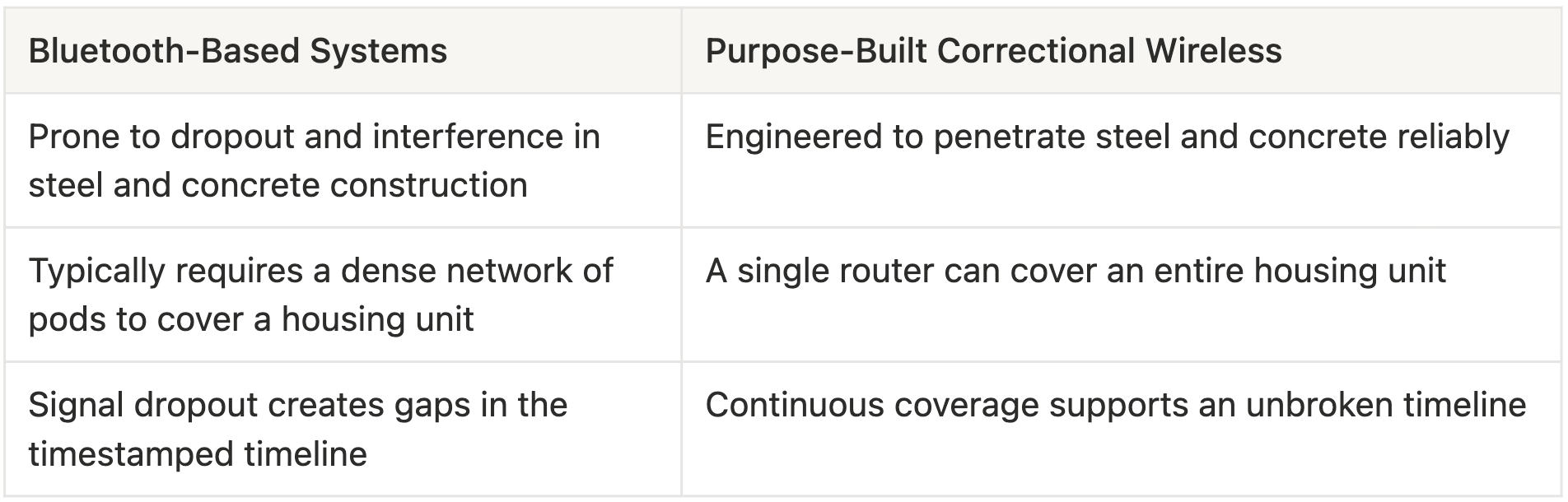
A wireless architecture that drops signal produces gaps in the timestamped record, and those gaps are exactly what opposing counsel will target during discovery.
OverWatch® runs on a wireless network engineered specifically for correctional facilities, not adapted from consumer wearables. It is infrastructure built for the construction most detention facilities are made of, not retrofitted to it.
Turning Sensor Data Into Evidence That Holds Up
Sensor output, on its own, is not a report. Converting biometric and location data into a defensible record takes structured formatting that translates raw signals into an account a judge or jury can follow.
This means clearly labeled data fields and consistent units of measurement. It also means contextual annotations wherever staff responded to a system alert, structured in the same chronological order the events actually unfolded.
Integration with existing jail management, offender management, or case management systems matters here. It typically happens through structured file transfer, letting monitoring data sit alongside other custody records rather than living in an isolated system staff must reconcile by hand.
Agencies should confirm, before deployment, that their technology can generate a structured, exportable report on demand, not only a live dashboard.
Reports generated directly from the platform reduce transcription errors. Manually compiled reports, pulled together after the fact from multiple sources, are far easier for opposing counsel to exploit.
OverWatch® is currently deployed across more than 72 jails and 80 agencies in 19 states, monitoring more than 50,000 individuals in custody. That scale means its reporting format has been used in real discovery requests, not just theoretical ones. The platform documents the record as events occur, so producing a defensible report adds no extra workload for the officers who generated the underlying observations.
The Pitfalls That Undermine Admissibility
Several recurring problems weaken an agency's position in litigation:
- Inconsistent formatting: records that vary across shifts or facilities make it difficult to demonstrate a uniform recordkeeping practice.
- Manual data entry: handwritten or after-the-fact entry introduces transcription errors and creates gaps between what a system captured and what staff recorded.
- Retention gaps: records purged before a litigation hold is considered can be just as damaging as records that were never created.
- Undocumented alert response: failure to document staff response to a system-generated alert leaves an incomplete account of what action was taken and when.
Each of these pitfalls is preventable, but only if addressed before a claim arises, not during discovery, when an agency's options for correcting the record are far more limited.
Treating monitoring data as purely operational, without legal counsel weighing in on retention and format, means the record was never designed with litigation in mind.
What This Means for Civil Rights Exposure
Most in-custody litigation is filed as a Section 1983 civil rights claim, not a simple negligence case. These claims often allege a violation of Eighth Amendment protections against cruel and unusual punishment, and adequate medical oversight sits at the center of that standard.
A jail's legal duty of care requires more than good intentions. Courts and plaintiffs' counsel look for proof that adequate oversight was actually in place, not just written into policy. Documentation is how that proof gets compiled.
The strongest defense against a civil rights claim is a record showing continuous, structured oversight.
That same record is the surest way to demonstrate a constitutional standard of care was met, not just claimed after the fact. It is central to any strategy for correctional liability management and the broader duty of care corrections agencies owe to everyone in their custody.
Records Built to Survive Cross-Examination
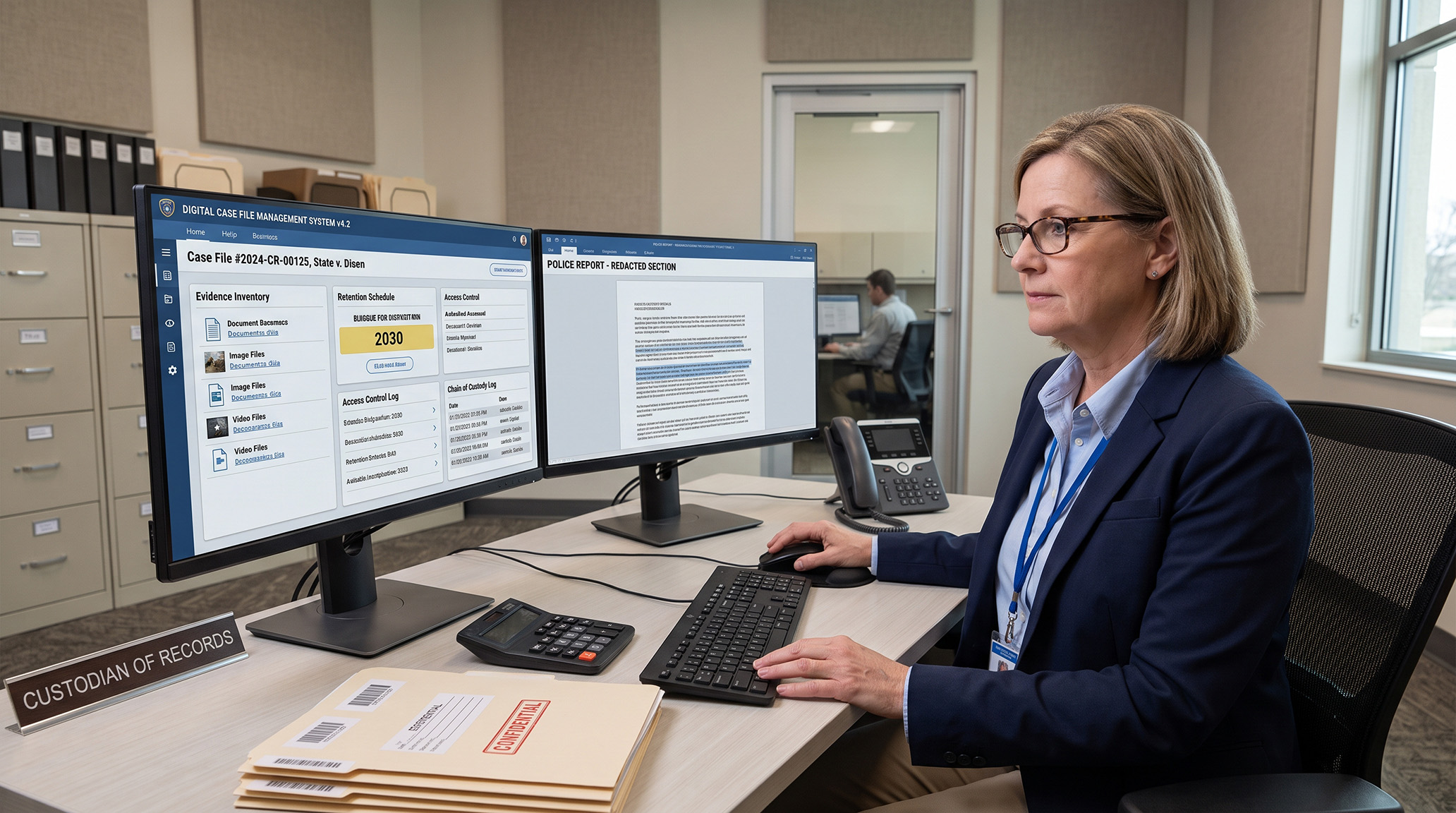
A record built for cross-examination is one a records custodian can explain clearly and consistently, without relying on memory.
This requires standardized formatting across the facility. It also requires automated timestamps, a documented audit trail, and integration with the facility's broader records systems.
Staff who may testify about the record should understand, in plain terms, how the data was captured. A witness who cannot explain the system undermines the record's credibility, regardless of its accuracy.
Agencies that periodically test their own ability to produce a complete, formatted record are better positioned.
Treat it as a readiness exercise, not a hypothetical, before opposing counsel makes the request for you.
Questions to Ask Any Monitoring Vendor About Chain of Custody
Agencies evaluating monitoring technology, from any vendor, should press on chain-of-custody integrity specifically, not just feature lists. The following questions apply regardless of which platform a facility is considering.
1. Timestamp Origin
Is the timestamp generated automatically by the system at the moment of capture, or entered or adjusted by staff afterward?
A timestamp that a person can edit after the fact is a timestamp opposing counsel can challenge. Ask the vendor to walk through exactly where in the pipeline the timestamp is created.
2. Access Logging
Does the system maintain its own record of who accessed or exported the data, and when?
A monitoring record without an access log invites questions about whether it was altered or selectively preserved, no matter how accurate the underlying data is.
3. Export Format
Can the platform generate a structured, exportable report on demand, not only a live dashboard view?
A live dashboard is not a discovery-ready document. Confirm the vendor can produce a formatted, standalone report without requiring staff to manually assemble one after a claim is filed.
4. Infrastructure Reliability
What is the system's track record for signal continuity in steel-and-concrete construction, and how are dropouts logged?
A gap in coverage becomes a gap in the record. Ask how the vendor's infrastructure was engineered for correctional facilities specifically, and how any outage is documented rather than simply left blank.
4Sight Labs built OverWatch® and OptiGuard™ around these same questions, not because they're unique to us, but because they're the ones that hold up when a record is actually tested in litigation.
What This Technology Does Not Do
OverWatch® and OptiGuard™, 4Sight Labs' correctional biometric and environmental monitoring platforms, are engineered to strengthen documentation, structured alerting, and operational awareness. They are support layers, not autonomous decision-makers, and staff verification and judgment remain central to every response.
- Not diagnostic: the platforms are not intended for diagnosis or treatment of any medical condition.
- Not a clinical substitute: monitored data is not a substitute for clinical evaluation by qualified medical personnel.
- Not a guarantee: no monitoring system can guarantee an outcome. Continuous biometric monitoring strengthens situational awareness across high-risk scenarios, giving staff the visibility to respond when conditions change. It does not replace staff judgment, staffing levels, or training.
- Not autonomous: alerts direct staff attention; they do not act on their own or make a determination about an individual's condition.
Frequently Asked Questions
What makes correctional monitoring data admissible in court?
Admissibility generally requires that a record be authenticated, that its source and handling be traceable, and that its format allow a factfinder to interpret it without specialized technical knowledge. A raw, unlabeled data export rarely meets that bar on its own.
Does automated timestamping replace the need for staff documentation?
No. Automated timestamps and audit trails strengthen the record and reduce the vulnerabilities of manual logging, but staff observation, judgment, and response remain a required part of custody operations.
How long should monitoring data be retained for potential litigation?
Retention schedules should be set with agency counsel and should account for litigation hold requirements, not just routine records-management policy. Purging data before a hold is considered can be as damaging as never having captured it.
Is biometric monitoring data used to diagnose a medical condition?
No. Biometric monitoring platforms such as OverWatch® are not intended for diagnosis or treatment. They generate structured alerts when monitored indicators shift, so staff can verify condition and respond; the clinical evaluation itself remains the responsibility of qualified medical personnel.
The format of monitoring records, not merely their existence, determines whether they help or hurt an agency in litigation. Building reporting practices around timestamping, audit trails, and structured output, before a claim arises, is what separates a defensible record from a discovery liability.
See how OverWatch® and OptiGuard™, 4Sight Labs' correctional biometric and environmental monitoring platforms, generate this record automatically, backed by 99.99% system uptime. Book a Demo to see the platform in action.
Correctional leaders seeking additional guidance on documentation practices can explore the 4Sight Labs Resource Center.