What Is Institutional Liability in a Custodial Death Case?
What Courts Actually Examine
Custodial Death Liability | When someone dies in custody, litigation rarely turns on a single dramatic failure. More often it turns on a record, and whether that record can withstand scrutiny from investigators, plaintiffs' counsel, and ultimately a jury.
Institutional liability in a custodial death case is the legal and financial exposure a facility faces when a court or investigator determines that its operational practices, not just its written policy, failed to meet the required standard of care. That determination rests less on what a policy says and more on whether the agency can prove, with a credible record, that the policy was actually followed.
The specific legal standard involved, negligence, deliberate indifference under federal civil rights law, or municipal liability, depends on the theory of the claim and the jurisdiction. This discussion describes general documentation and investigative patterns, not legal standards for any specific case.
This discussion focuses on operational supervision and documentation considerations in custodial environments and is not intended to provide clinical, medical, or legal guidance. Correctional healthcare decisions should always be directed by qualified medical professionals and applicable facility policy, and liability questions should be directed to agency counsel.
The Pattern Behind Custodial Death Claims
In 2019, the most recent year with finalized federal data, local jails reported 1,200 deaths to the U.S. Bureau of Justice Statistics, a more than 5 percent increase from the prior year, with suicide accounting for the largest single share of causes. (Source: Bureau of Justice Statistics, Mortality in Local Jails, 2000–2019)
Across the litigation that follows these cases, the underlying complaints cluster around a narrow set of operational failures: missed or falsified observation rounds, gaps between required checks, delayed recognition of a change in an individual's condition, and documentation that cannot substantiate what staff actually did during the critical window before death.
Plaintiffs' attorneys and their expert witnesses have grown skilled at identifying where a facility's paper trail contradicts its own policy, or where logs show suspiciously uniform intervals suggesting rounds were not performed as documented.
Liability rarely stems from the absence of a policy. It stems from the inability to prove the policy was followed.
For sheriffs and procurement officers evaluating litigation exposure, that pattern is instructive. Settlement and judgment exposure in custodial death litigation can run substantial. Case values are highly fact-specific and vary by jurisdiction, and any figure cited for a specific matter should be confirmed against public court records rather than treated as a category average.
Documentation Is the First Line of Defense
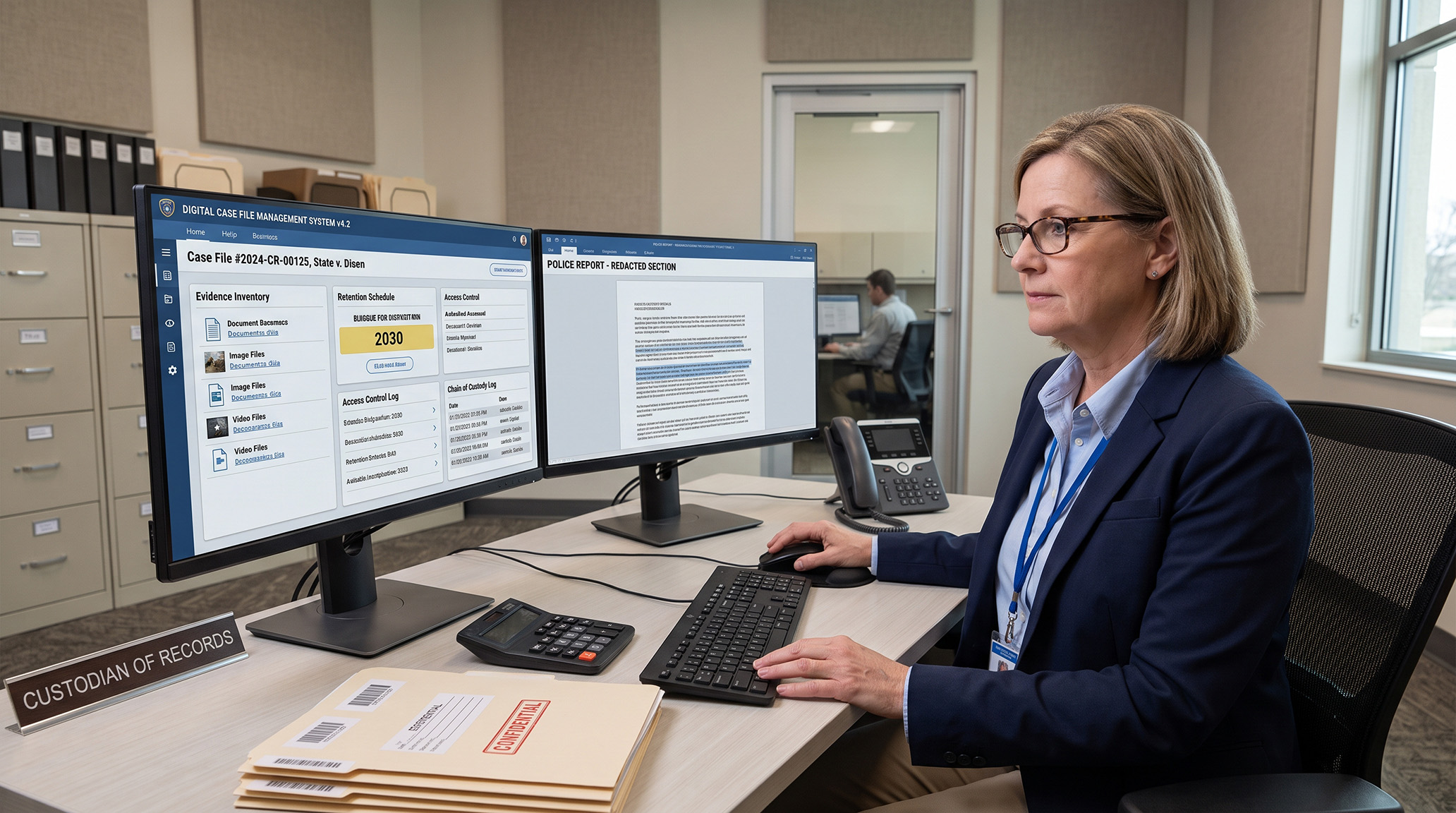
In custodial death litigation, documentation functions less as an administrative byproduct and more as the primary evidentiary record of what occurred. Courts and investigators reconstruct the hours or days preceding a death almost entirely from what staff wrote down, when they wrote it, and whether the timestamps align with other available evidence.
A facility's defense is only as strong as its documentation.
Well-intentioned supervision that leaves no verifiable trace is difficult to distinguish, in a legal proceeding, from supervision that never happened. That is what makes documentation practice, not just documentation policy, the central issue in litigation.
A facility that can produce a precise, time-stamped, and independently verifiable account of observation activity is in a materially different position than one relying on handwritten logs completed after the fact. Documented timelines support accountability precisely because they remove ambiguity about what staff observed and when: the foundation of the duty of care correctional agencies owe to everyone in their custody.
Where Missed Rounds Become Legal Exposure
Observation gaps and liability gaps are frequently the same gap, viewed from two different vantage points. A missed check that goes unnoticed operationally becomes, in retrospect, the moment plaintiffs' counsel identifies as the point where intervention should have occurred.
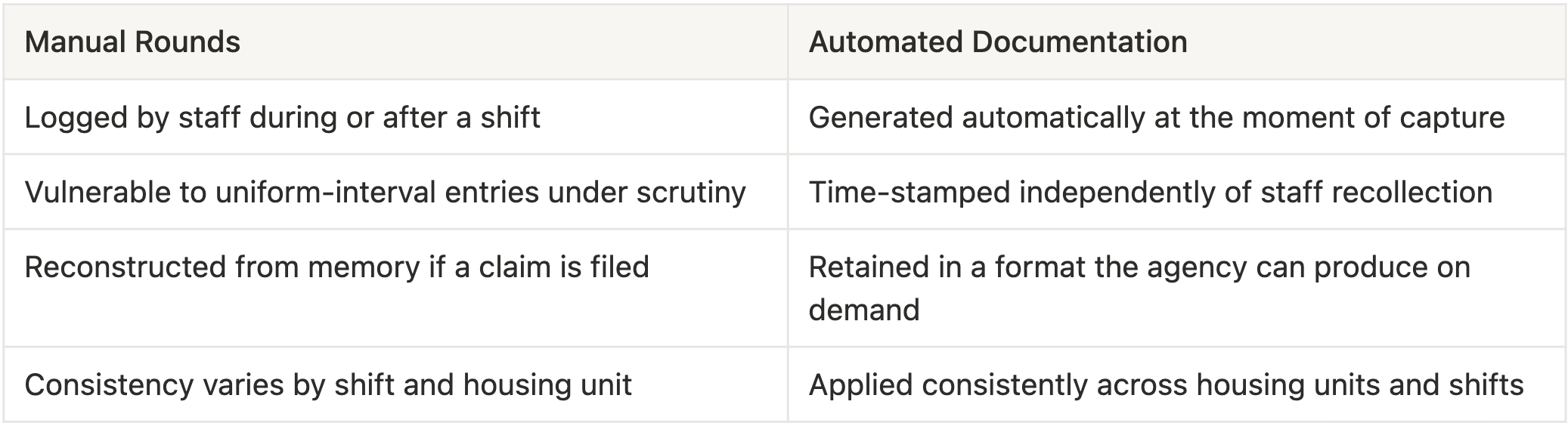
The interval between required rounds, whether fifteen minutes or thirty, is precisely where a deteriorating condition is most likely to go unobserved, and where the record is most likely to be challenged later. Manual rounds are also vulnerable to a specific and recurring criticism: log entries that are uniform to the minute, or clearly batch-completed rather than recorded contemporaneously. Even when supervision was adequate, a log that looks fabricated undermines a facility's credibility on every other point in dispute.
Closing this gap requires supervision records generated automatically and independently of staff recollection, rather than reconstructed from memory at the end of a shift.
What Investigators and Courts Actually Examine
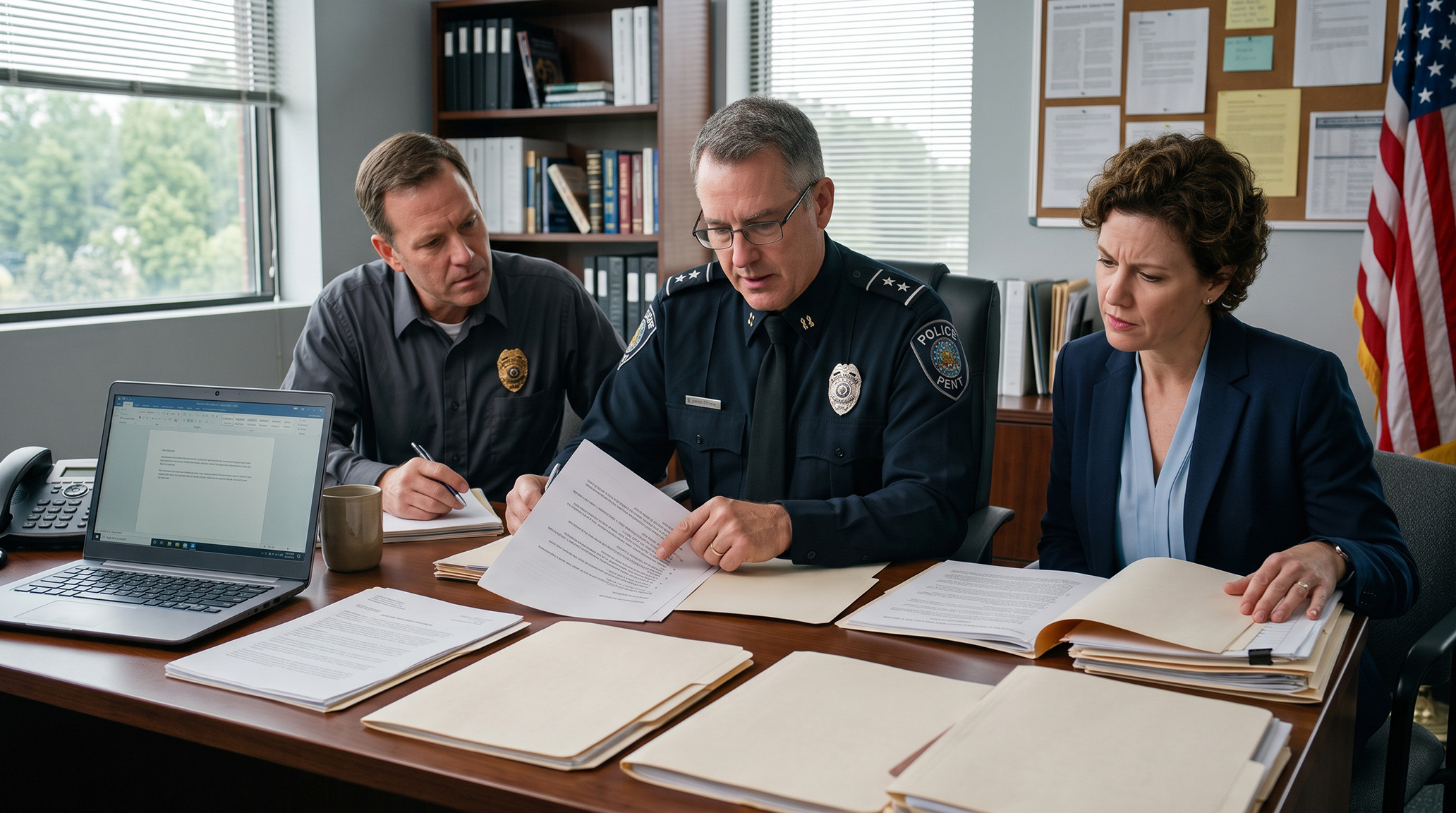
Investigators reviewing an in-custody death typically work through a narrow, consistent set of questions:
- Interval compliance: was the individual observed at the required interval, and can the agency prove it with a record that predates the claim?
- Condition changes: was any change in presentation or behavior noted, and was it acted upon consistent with policy?
- Policy alignment: was the staff response consistent with training and written procedure?
- Record integrity: can the facility substantiate its answers with documentation that was not created after the fact?
Courts weigh credibility heavily in these cases. Documentation that is internally consistent, precisely time-stamped, and corroborated by an independent system carries far more evidentiary weight than logs alone. Investigators are also attentive to whether a facility's technology and staffing practices reflect current, defensible standards within the field, or whether the facility relied solely on manual processes that leave significant room for error or dispute.
Questions to Ask Any Monitoring Vendor About Documentation
Agencies evaluating monitoring technology, from any vendor, should press on documentation integrity specifically, not just feature lists. The following questions apply regardless of which platform a facility is considering.
1. Timestamp Generation
Are timestamps generated automatically at the moment of capture, or reconstructed later by staff?
A record assembled after the fact carries less evidentiary weight than one generated in real time by the system itself, independent of who is on shift.
2. Independent Verification
Can the record be corroborated by a second, independent data source?
A single log is easier to challenge than two independent systems, for example wearable biometric data and fixed-environment activity data, that point to the same account of events.
3. Consistency Across Shifts and Units
Does the documentation practice hold up the same way across every housing unit and every shift?
A record that looks different from one shift to the next, or one unit to the next, invites the argument that observation practice, not just the paperwork, was inconsistent.
4. Audit and Production Speed
How quickly can the agency produce a complete, credible record when a claim arises?
Litigation timelines move fast. A facility that cannot retrieve and produce its own observation record efficiently starts every review at a disadvantage.
4Sight Labs built OverWatch® and OptiGuard™ around these same questions, not because the questions are unique to us, but because they are the ones that hold up under investigation, regardless of vendor.
Building a Defensible Record Without Adding Workload
An institutionally defensible record is built before litigation begins, not assembled in response to it. That means observation and supervision data captured automatically, time-stamped independently of staff input, and retained in a format that can be produced quickly and credibly when a claim arises.
It also means documentation practices that stay consistent across housing units and shifts, so that no single record stands out as an anomaly under scrutiny. Facilities that pair trained staff judgment with continuous, technology-supported awareness of individuals in custody are better positioned to demonstrate that supervision occurred as required.
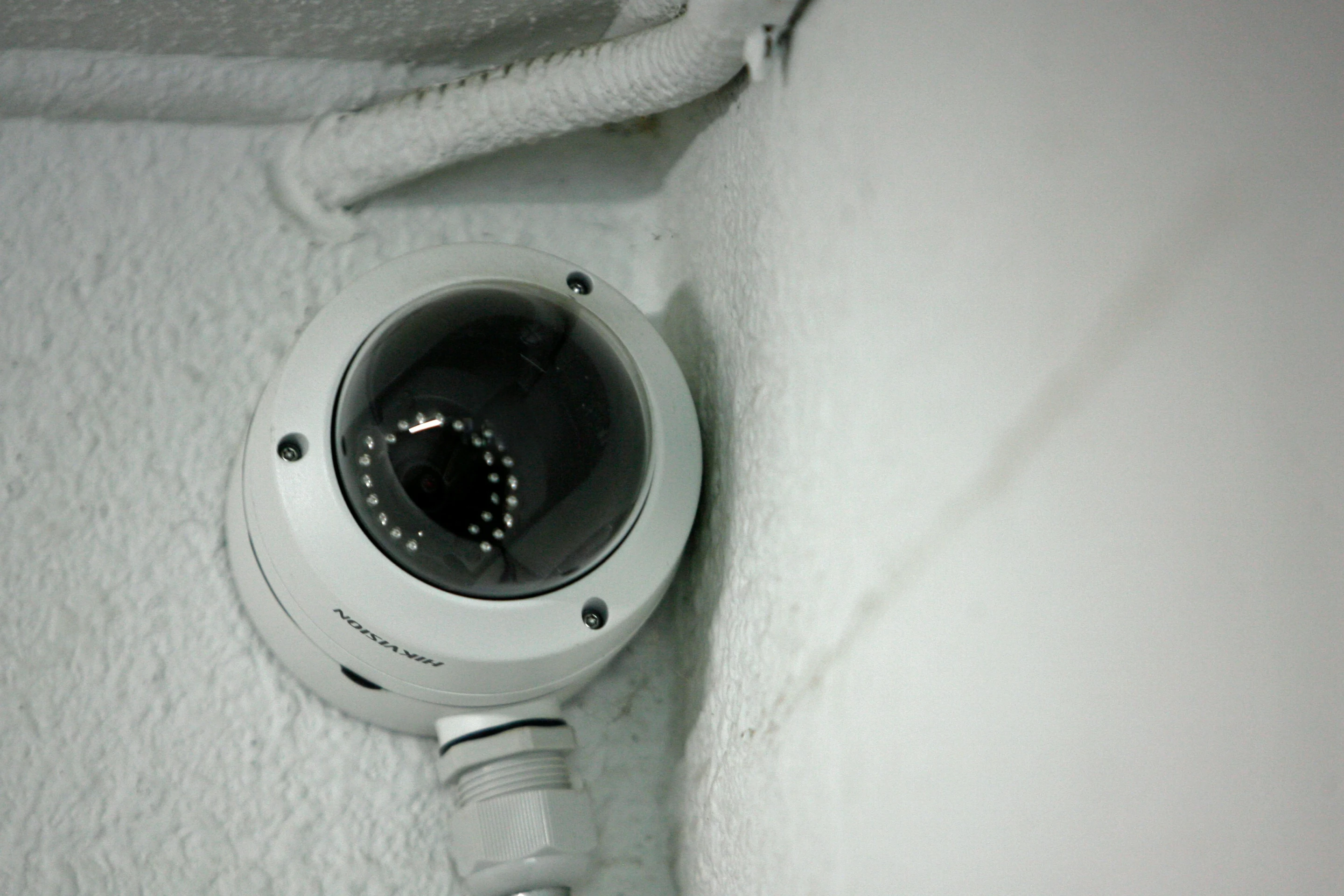
OptiGuard™, 4Sight Labs' camera-based environmental monitoring layer, extends this record into the housing unit itself. Rather than requiring staff to conduct and log a physical check to confirm presence and movement, OptiGuard™ uses a facility's existing camera infrastructure to generate a continuous, time-stamped account of in-cell activity automatically, through a darkened, silhouette-style view rather than raw video, with privacy by design.
Paired with wearable biometric data from OverWatch®, 4Sight Labs' wearable biometric monitoring platform for correctional environments, this gives agencies a documented account of both physiological indicators and in-cell activity across the same window investigators and courts scrutinize most closely, without asking staff to generate that record by hand.
This is not a substitute for staffing or training. It is a complement that closes the specific gaps where documentation, rather than intent, has repeatedly determined litigation outcomes.
What This Technology Does Not Do
OverWatch® and OptiGuard™ are engineered to strengthen operational awareness, structured alerting, and documentation. They are support layers, not autonomous decision-makers, and staff verification and judgment remain central to every response.
- Not diagnostic: the platforms are not intended for diagnosis or treatment of any medical condition.
- Not a clinical substitute: monitored data is not a substitute for clinical evaluation by qualified medical personnel.
- Not a guarantee: no monitoring system can guarantee an outcome. Continuous biometric monitoring strengthens situational awareness across high-risk placements, giving staff the visibility to respond when conditions change. It does not replace staff judgment, staffing levels, or training.
- Not autonomous: alerts direct staff attention; they do not act on their own or make a determination about an individual's condition.
Frequently Asked Questions
How often should observation rounds happen in high-risk custody placements?
Interval requirements are set by agency policy and often by state or accreditation standards, commonly ranging from every fifteen to thirty minutes for high-risk placements. What matters most in litigation is not just the interval chosen, but whether the agency can prove that interval was actually met.
What do investigators look at first in a custodial death review?
Investigators typically start with interval compliance and record integrity: whether the required checks occurred and whether the documentation can be verified as contemporaneous rather than reconstructed after the fact.
Does monitoring technology replace observation rounds performed by staff?
No. Monitoring technology is designed to strengthen awareness and documentation around staff observation, not replace it. Staff verification and response remain a required part of custody operations.
Is biometric monitoring data used to diagnose a medical condition?
No. Biometric monitoring platforms such as OverWatch® are not intended for diagnosis or treatment. They generate structured alerts when monitored indicators shift, so staff can verify condition and respond. The clinical evaluation itself remains the responsibility of qualified medical personnel.
Institutional liability in custodial death litigation is ultimately a documentation question as much as an operational one: the record an agency keeps is the clearest evidence of whether its duty of care was met.
Correctional leaders seeking additional resources on custodial risk and oversight can explore the 4Sight Labs Resource Center.