Inmate Monitoring Systems: In-Custody Monitoring

In-Custody Monitoring, Not a Release Tracker
An inmate monitoring bracelet is a wrist- or ankle-worn sensor used inside a correctional facility to support safety and welfare checks. OverWatch® by 4Sight Labs uses a sensor that monitors biophysiological signals, and system algorithms determine if a welfare check is needed. When one is, staff get a notification to go check on the individual in person. It is not a court-ordered location tracker for people on release. OverWatch® and OptiGuard™ are not medical devices and are not intended to diagnose, treat, cure, mitigate, predict or prevent any disease or condition.
First, what a monitoring bracelet is not
OverWatch® is built for individuals inside the facility. Most search results for this phrase are about ankle monitors. Those are court-ordered devices that track where someone on pretrial release or house arrest is. The U.S. Courts' overview of federal location monitoring explains how that community supervision works.
OverWatch® serves a different setting. It supports safety and welfare checks for individuals in custody. It can be worn on the wrist or the ankle, and it doesn't track anyone outside the walls. If you're looking for release supervision, this article won't help. If you want continuous awareness of the individuals in your housing units, keep reading.
What does the bracelet do?
The bracelet tells staff when a welfare check is needed. The OverWatch® sensor works in the background between rounds. It monitors biophysiological signals continuously, and system algorithms determine if a welfare check is needed. When one is, staff receive a notification to check on the individual.
The bracelet doesn't use fingerprints or face scans. It is assigned to one individual when it's issued and isn't used to identify anyone.
How does it stay on?
The band is built to resist tampering.
- Pull strength. The band has 250 lb pull strength.
- Battery life. The battery lasts 14 days.
- Device notifications. If a band is damaged or its battery runs low, staff get a system notification on the same dashboard. The issue is documented right away.
Staff choose wrist or ankle placement for each individual when the device is issued.
How does the data get out of the housing unit?
OverWatch® runs on its own network, built for correctional buildings. Concrete and steel can block ordinary Wi-Fi and consumer wireless devices. The OverWatch® network is designed to work through those structures, from a single observation cell to a multi-building campus. Our press release on why consumer wireless technology falls short in custody explains why that matters. The how it works page shows the setup.
4Sight Labs maintains an annual SOC 2 audit program. Access to records is limited by role.
What do staff see?
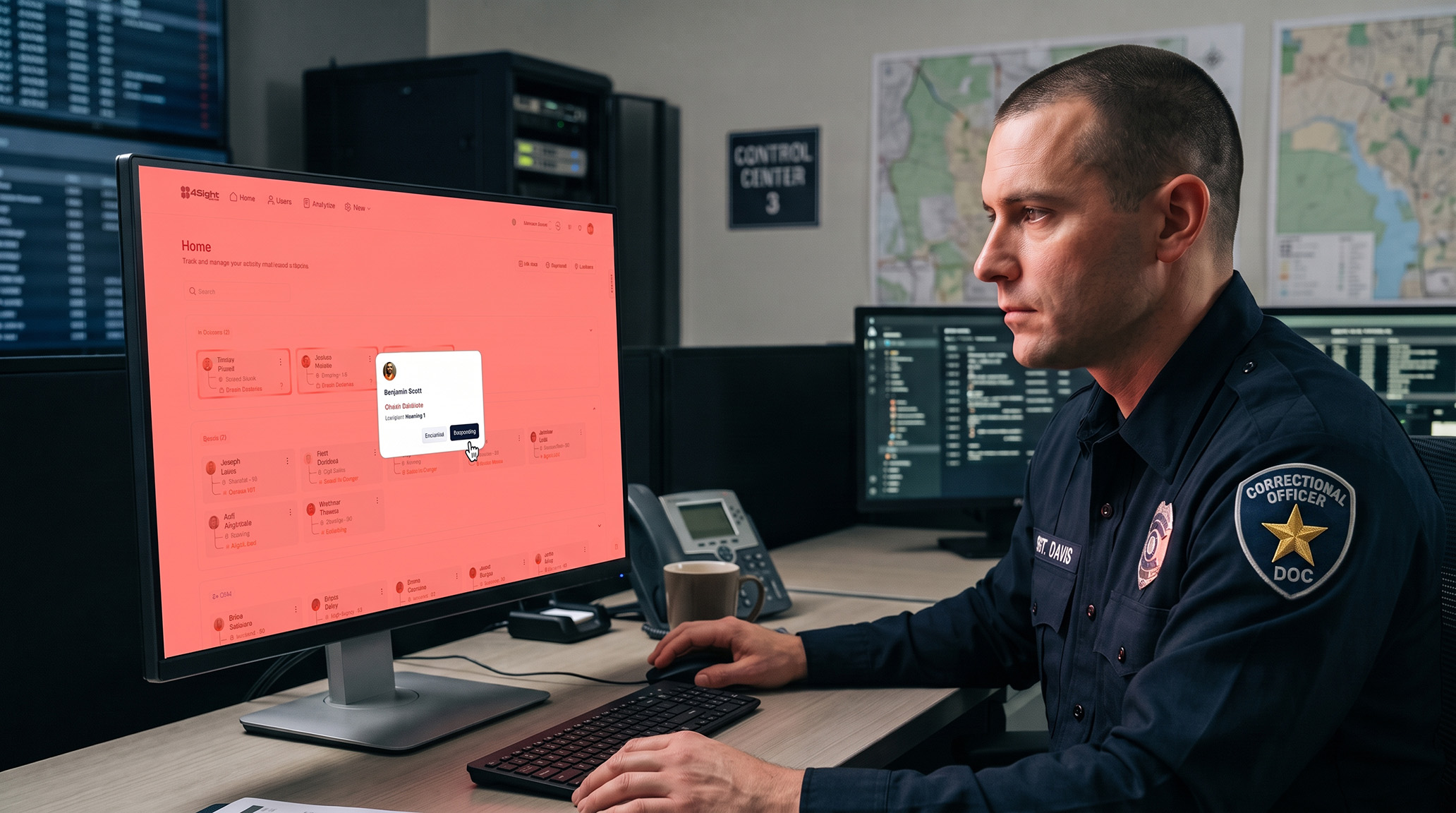
Staff get a notification to check on the individual. They never see readings, thresholds or trends. The notification names the individual and their location zone inside the facility. It tells staff to check on them in person, and it doesn't say what triggered it.
The command dashboard displays notifications and facility location zones. It also shows device status. Notifications can also reach handheld devices through the Command Cloud® mobile app. This is optional, and OverWatch® works fully without it.
Here's the process:
- Issued at intake, or when someone moves into a monitored area.
- Monitoring runs in the background over the facility's own OverWatch® network.
- A notification tells staff to do a physical welfare check.
- Staff respond under agency policy, and the response is time-stamped.
- The record supports internal review and outside oversight.
Who wears one?
The agency decides who wears a sensor. It's a custody and housing decision made at intake, and the provider can give input. The agency applies its own written criteria. Planning often starts with intake, heightened-observation status and other high-risk placements. Agencies can then expand as policy evolves.
Inmate monitoring bracelet and inmate bracelet monitoring
These phrases describe the same device and program.
- Inmate monitoring bracelet: the OverWatch® sensor issued inside a facility.
- Inmate bracelet monitoring: the program around it, from issue at intake to the exported record.
- Prison use: the same sensor and program, applied in a prison setting.
None of them is a parole or pretrial tracker.
How does it work with cameras and rounds?
Wearable and camera-based monitoring work side by side. Agencies use "bracelet" and "wristband" to mean the same thing, and 4Sight Labs uses one wearable for both. OptiGuard™ is the camera-based partner to the bracelet. It applies Liveness-Detection™ to the cameras a facility already has. It notifies staff to check the cell in person when no motion is detected.
Both share one dashboard. Both supplement officer rounds, and staff still perform required checks under facility policy. OverWatch® is also engineered to integrate with the facility management and records systems an agency already uses.
Safeguards and limitations
Each capability has a limit staff should plan around. Continuous monitoring can notify staff between rounds. It does not replace required physical checks or guarantee that every concern will generate a notification.
Facility location zones help staff find an individual inside the monitored area. They are not GPS release supervision. Device notifications flag damage or a low battery. Staff still inspect equipment and follow maintenance procedures.
The time-stamped record supports stronger documentation for post-incident review. Its completeness depends on staff documenting the actions they take.
Why OverWatch®?
Reported deployment figures give context for the platform's use.
- Designed and assembled in the USA.
- SOC 2 audited, with the 2026 SOC 2 audit underway.
- 70,000+ individuals monitored as of October 2026.
- 300+ agency-reported interventions as of October 2026.
The intervention figure reflects agency-reported interventions. It is not a count of lives saved or a guarantee of an outcome.
Explore the Resource Center for more on correctional monitoring. Want to see it in your facility? Schedule a demonstration.
Frequently asked questions
Is an inmate monitoring bracelet a GPS ankle monitor?
No. GPS ankle monitors track where people on release are. The OverWatch® bracelet supports safety and welfare checks for individuals inside a facility. It can be worn on the wrist or ankle, and it isn't release supervision.
Does it identify people by fingerprint or face?
No. The bracelet is assigned to one individual when it's issued. It doesn't use fingerprints or face scans.
How long does the battery last?
Fourteen days. Staff get battery-status notifications on the same dashboard as welfare check notifications.
What are the limits of the products' intended use?
OverWatch® and OptiGuard™ are not medical devices and are not intended to diagnose, treat, cure, mitigate, predict or prevent any disease or condition. Staff don't see readings or thresholds, and the notification doesn't identify the signal that triggered it. Notifications direct staff to do a physical welfare check under agency policy. The products do not replace required checks or facility policy.