
State Jail Observation Compliance

Q15 Minute Checks | State Jail Observation Compliance
How agencies document Q15 checks and other interval requirements under their state's specific standards.
It's easy to assume the challenge of Q15 checks and other observation-interval requirements is remembering to document them. It isn't, at least not primarily.
The harder problem is ensuring the observation itself happens on schedule when the officers responsible for it are also managing emergencies, transports, medical events, meals, counts, and every other demand competing for the same few minutes.
The specific interval, who it applies to, and how it must be documented are still set independently by each state's jail standards agency, and in some cases by accrediting bodies layered on top, but meeting that requirement starts with the round actually happening, not with the paperwork afterward.
State jail inspection compliance, in practice, means an agency can show two things at once: that observation occurred at the specific interval its state or accrediting body requires, for the population that interval applies to, and that the record proving it exists independently of what any one officer remembers or reports after the fact.
This discussion focuses on operational supervision and documentation considerations in custodial environments and is not intended to provide legal or regulatory guidance. Compliance questions should be directed to agency counsel and the relevant state jail standards agency.
What Actually Sets the Requirement
Every state that regulates its jails sets its own observation-interval requirement, typically through a jail standards commission, a state corrections oversight body, or administrative code, and inspectors from that body are the ones who determine whether a facility passes review.
Some states set a single interval for all detainees. Others tier the requirement by risk category, with a shorter interval for individuals who are assaultive, in crisis, or otherwise flagged for closer supervision. The American Correctional Association's voluntary accreditation standards add a third layer many facilities also carry, on top of whatever their state already requires.
A facility's actual obligation is the most restrictive interval that applies to it, not the most common one nationally.
For command staff managing multiple housing units, this means the correct interval for a given cell block depends on that unit's risk classification and the specific state text governing the facility, not a number a neighboring state or a national association happens to use.
How Observation Interval Requirements Vary by State and Accrediting Body
The table below compares several publicly documented state requirements alongside the American Correctional Association's accreditation standard, current as of this writing. Agencies should confirm the exact, current text of their own state's requirement directly, since standards are periodically revised.
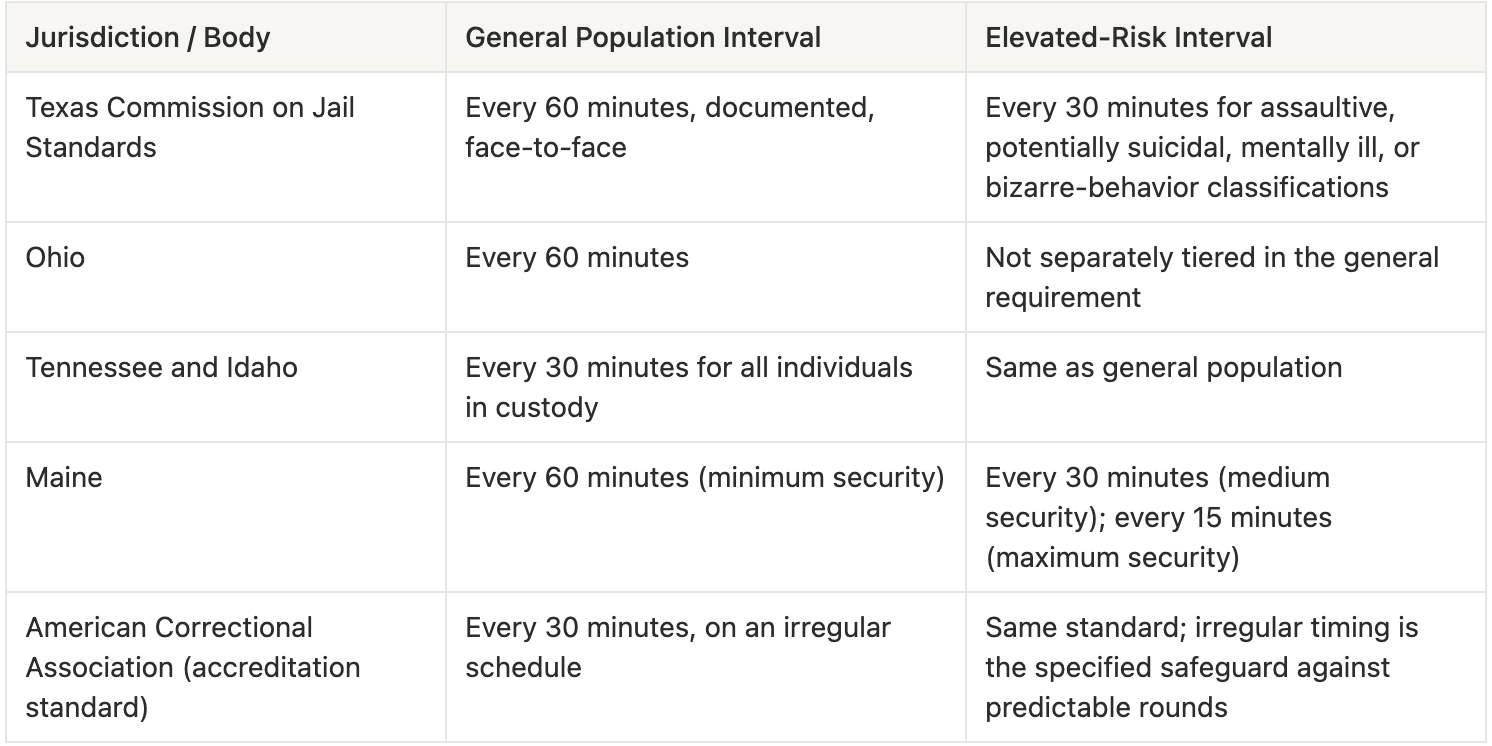
(Sources: 37 Tex. Admin. Code § 275.1, via Cornell Law School's Legal Information Institute; state interval summaries and the ACA Core Jail Standards/4th Edition Performance-Based Standards, as compiled by the National Institute for Jail Operations.)
A recurring pattern across nearly every version of this requirement, regardless of state, is the "irregular schedule" element the ACA standard makes explicit: a predictable, clockwork interval is treated as a weaker safeguard than one that varies, since predictability is exactly what allows a genuine gap in supervision to go unnoticed.
What a State Inspector Actually Checks For
A state jail inspection rarely stops at confirming a policy document states the correct interval. Inspectors typically sample the facility's actual observation logs and compare stated policy against documented practice.
- Interval compliance: did checks occur at or inside the required interval, for the correct population, consistently across the review period?
- Documentation completeness: is each check time-stamped and attributable to a specific staff member, not entered as a block or batch?
- Plausibility: do timestamps reflect realistic, staggered timing, or do they look uniform in a way that suggests the round was logged rather than performed?
- Classification accuracy: were individuals correctly assigned to the risk category that determines which interval applies to them?
An inspector's finding rarely turns on whether a policy exists. It turns on whether the facility's own records demonstrate that the policy was followed.
How Staffing Constraints Turn Into Missed or Late Rounds
The pattern above assumes the round happens on schedule and only the paperwork is at issue. In most facilities, that assumption doesn't hold. The officers responsible for a Q15 or other interval check are often the same officers responding to an emergency, escorting a transport, managing a medical event, running a meal service, conducting a count, or handling another demand competing for the same block of time.
When staffing is tight, something has to give, and it's often the round that slips first, delayed past the required interval or skipped for one cycle and made up late. That's an operational reality of running a housing unit against a fixed staff-to-detainee ratio, not a training gap or a matter of officers forgetting the requirement.
A missed or late round is a different problem than a missed log entry. The observation itself didn't occur at the interval the state requires, for the population that interval applies to, regardless of what any record produced afterward shows.
How Manual Logs Can Fall Short of Jail Standards Documentation Requirements
Paper and simple digital logs compound this problem rather than solving it. Their vulnerability is well documented: entries completed after the fact rather than at the moment of the check, multiple checks logged in a batch at shift's end, and intervals that read as suspiciously uniform to the minute, often the result of a stretched officer catching up on paperwork between other demands instead of at the moment of each round.
The deeper issue isn't whether a check gets logged. It's whether the log can be verified. A manually entered observation log records what staff say occurred. It does not, on its own, establish an independent record of what actually happened at that interval. A technology-generated record is different in kind, not just in format: it can provide an independent, timestamped record of what the system observed at the time of the check, generated automatically rather than typed in afterward.
Inspectors, and later plaintiffs' counsel in litigation, are trained to look for exactly the patterns a manual log produces under staffing pressure. A log that looks formulaic damages a facility's credibility even in cases where the underlying supervision was performed correctly, because it invites doubt about every other record the facility produces.
That gap, between a check that was recorded and a check that can be verified, is where liability and compliance exposure concentrate. When a missed or late round can't be independently confirmed either way, the agency is left defending its practice on an officer's recollection rather than a record, in exactly the kind of case where settlements for custodial incidents have recently ranged from $3.5M to $27M nationally.
Building a Compliance-Ready Documentation Practice
A documentation practice built for inspection readiness, rather than assembled reactively before a review, generally shares a few characteristics: timestamps generated automatically rather than typed in by staff, records that can be filtered and produced quickly by housing unit and date range, and consistency across every shift and unit rather than variation that stands out under sampling.
OverWatch®, 4Sight Labs' wearable biometric monitoring platform for correctional environments, and OptiGuard™, its camera-based in-cell monitoring layer, are both engineered to generate this kind of record automatically, independent of staff recollection, across every housing unit an agency operates.
OptiGuard works from the cameras a facility already has installed. It applies OptiGuard's own Liveness-Detection™ technology to each cell at set intervals, verifying presence and observation rather than requiring an officer to walk the round and confirm it in person. That verification does two things in the same motion: it supports the observation itself, and it generates the automated documentation of the round, producing a searchable, exportable record by housing unit and date range.
One side of the platform is the observation layer; the other is the officer's duty-of-care rounds documentation, and OptiGuard is built to strengthen both without requiring a separate manual documentation step.
Neither OverWatch nor OptiGuard replaces the observation round itself. Both are built to produce the documented, independently verifiable account, distinct from a manually entered log, that an inspector or a court will eventually examine.
Questions to Ask Any Monitoring Vendor About Inspection Readiness
Agencies evaluating monitoring technology for inspection readiness should press on documentation specifics, not just feature lists. The following questions apply regardless of which platform a facility is considering.
1. Interval Configuration
Can the system be configured to the specific interval and risk-tiering your state actually requires, rather than a single fixed default?
A platform built around one generic interval may not match a state standard that tiers by classification.
2. Timestamp Independence
Are timestamps generated automatically at the moment of capture, or can staff edit them after the fact?
An editable timestamp carries the same vulnerability under inspection as a handwritten log.
3. Export for Inspection
Can the agency produce a complete, filtered record by housing unit and date range on short notice, in a format an inspector can review directly?
A system that requires manual reconciliation across multiple logs starts an inspection at a disadvantage.
4. Consistency Across Units and Shifts
Does the documentation practice hold up the same way across every housing unit and every shift, or does it vary by who is on duty?
Inconsistency invites the same scrutiny inspectors already apply to manual logs.
4Sight Labs built OverWatch® and OptiGuard™ around these same questions, not because they are unique to us, but because they are what a state inspector actually tests for, regardless of vendor.
What 4Sight Labs Does Not Claim
OverWatch® and OptiGuard™ are engineered to strengthen documentation and observation awareness. They are support layers, not autonomous decision-makers, and staff verification and judgment remain central to meeting any state's observation standard.
- Not diagnostic: the platforms are not intended for diagnosis or treatment of any medical condition.
- Not a clinical substitute: monitored data is not a substitute for clinical evaluation by qualified medical personnel.
- Not a guarantee: no monitoring system can guarantee inspection results or compliance outcomes. It supports documentation of observation practice; it does not replace staff judgment, staffing levels, or training.
- Not a substitute for the check itself: the system documents presence and timing; it does not perform the welfare check or the judgment that check requires.
Frequently Asked Questions
Is there a single national observation-interval requirement for jails?
No. Each state's jail standards agency sets its own requirement, and accrediting bodies such as the American Correctional Association add a separate, voluntary standard many facilities also carry. Agencies must comply with whichever requirement applies to them directly.
Why do required observation checks get missed even when policy requires them?
Most missed or late rounds are a staffing problem rather than a failure of intent. The officers responsible for a check are often managing an emergency, a transport, a medical event, meals, a count, or another competing demand at the same time the check is due, and under a fixed staff-to-detainee ratio, the round is often what slips first.
What is the most common observation interval among the states that specify one?
Common intervals include 30 minutes and 60 minutes for general population, with several states and the ACA standard requiring shorter, tiered intervals, often 15 to 30 minutes, for individuals classified as higher risk. The exact figure depends entirely on the governing state or accrediting body.
Does a written policy satisfy a state inspection on its own?
No. Inspectors typically sample actual observation logs and compare them against stated policy, looking for interval compliance, documentation completeness, and plausible, non-uniform timestamps.
Can technology replace the physical observation round?
No. Monitoring technology is designed to strengthen documentation and awareness around staff observation, not replace it. The physical check and the judgment it requires remain a required part of custody operations under every state standard reviewed here.
Observation-interval compliance is ultimately a staffing and verification question as much as a documentation one: agencies that can show, with an independently verifiable record, that they met their specific state's requirement are in a materially stronger position heading into any review.
Correctional leaders seeking additional resources on custodial risk and oversight can explore the 4Sight Labs Resource Center.


.jpg)