Detention Risk Management

How Leadership Decisions Shape Institutional Exposure
For sheriffs, jail administrators, and executive command staff, detention risk management is a structural problem. Institutional exposure is shaped by decisions leadership makes about how high-risk detainees are identified, housed, observed, documented, and escalated throughout confinement, long before any critical event occurs. This discussion addresses operational supervision and risk management considerations in custodial environments. It is not intended to provide legal or clinical guidance.
How Leadership Decisions Drive Detention Risk Management Outcomes
Most custody-related incidents do not appear without warning. They develop through a sequence of compounding gaps: a housing decision that underestimated acuity, an observation model that assumed stability, documentation that recorded task completion rather than meaningful awareness, and escalation pathways that were unclear when conditions changed.
None of those gaps are accidents. They reflect leadership decisions, or the absence of them.
Detainees entering custody during detox, withdrawal, overdose concern, suicide watch, or behavioral instability represent predictable concentrations of risk. Managing that risk effectively requires more than a policy that acknowledges it. It requires a system deliberately designed around how elevated-risk confinement actually unfolds.
The Hidden Layers Where Custodial Liability Compounds
Institutional exposure rarely originates from a single failure. It compounds through layers of weakness that individually appear manageable but collectively create significant vulnerability.
Common compounding factors include:
- Housing placements that do not reflect the actual level of clinical or behavioral concern
- Observation intervals that are too general for the acuity of detainees assigned to the unit
- Staffing structures that spread officers across too many competing demands
- Documentation practices that confirm a check occurred without capturing what staff actually observed
- Communication gaps between custody personnel and healthcare staff during high-risk periods
For command staff, these gaps are often invisible in routine operations. They become visible only when a serious event brings the oversight model under external scrutiny.
Minimum Compliance Isn't Enough to Manage Custody Risk
A detention facility that meets its minimum compliance requirements may still carry significant institutional exposure. Compliance confirms that a policy was in place. It does not demonstrate that the policy was sufficient for the level of risk actually present.
In post-incident reviews and litigation related to custody deaths, investigators consistently ask a deeper question: did the institution's oversight model account for the realities of the detainee's condition and confinement context? Written rounds, general supervision language, and intake screening results rarely answer that question on their own.
The gap between policy compliance and operational credibility is where most detention risk management failures live.
Documentation Shapes Detention Risk Management
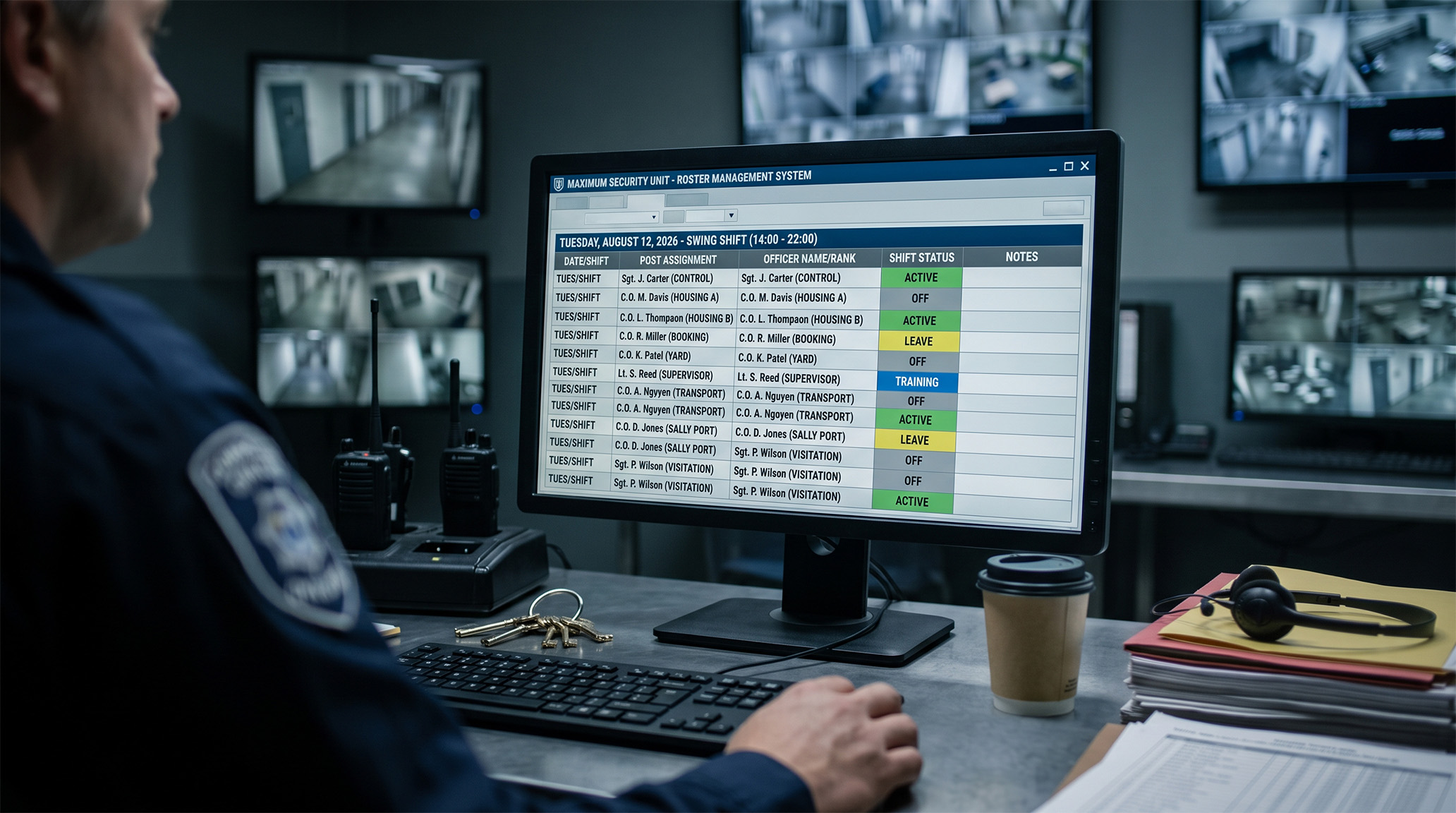
Documentation is not a secondary administrative task. In high-risk custody environments, it is one of the primary instruments of institutional defensibility.
Post-incident reviews examine timelines, housing decisions, observation records, and communication logs. When that record reflects only that rounds occurred, without capturing changes in presentation, responsiveness, or staff concern, the agency may struggle to demonstrate that developing risk was being actively recognized and managed.
Strong documentation in high-risk units should capture meaningful awareness, not just task completion: what staff observed, whether behavior or responsiveness changed, and what actions those observations prompted.
How Purpose-Built Monitoring Technology Closes Critical Oversight Gaps
Structured oversight does not depend on technology alone, but purpose-built monitoring systems can meaningfully extend awareness between direct observations: the intervals where many custody incidents develop.
Wearable biometric monitoring systems such as OverWatch®, part of the Unified Correctional Biometric Platform developed by 4Sight Labs, continuously track heart rate, blood oxygen levels (SpO₂), skin temperature, and motion. When values shift outside established thresholds, staff receive alerts that support timely wellness checks and prompt documentation of the institutional response.
Fixed-environment monitoring systems such as OptiGuard™ extend awareness into individual cells using existing camera infrastructure to detect liveness and movement between rounds, without requiring new hardware.
Across more than 80 correctional facilities and over 4,000,000 hours of biometric data collected from more than 50,000 individuals in custody, this layered approach has demonstrated that operational credibility in high-risk settings is achievable at scale.
Key Questions Every Jail Leader Should Ask Before a Custody Incident
For sheriffs and executive command staff, detention risk management requires evaluating the oversight model against the realities of elevated-risk custody, before an event and not after.
Key questions for structuring that evaluation:
- Are high-risk detainees being identified consistently at intake, with housing decisions that reflect their actual acuity?
- Are observation intervals and supervision expectations realistic given current staffing levels and unit design?
- Does documentation capture meaningful awareness of changing conditions, or only confirm routine activity?
- Are escalation pathways between custody and healthcare personnel clearly defined and actively used?
- Does the monitoring technology deployed in high-risk housing maintain reliable connectivity across the facility's reinforced structure?
These are the questions that determine whether an institution's risk management posture is defensible, not only on paper, but under the scrutiny that follows a serious custodial event.
Setting a Risk Management Standard That Holds Under Scrutiny
Risk in detention settings is not shaped solely by what happens at the moment of a critical event. It is shaped by the supervision model, documentation practices, staffing alignment, and oversight structure that leadership builds well before that moment arrives.
Facilities that have deliberately aligned those elements around the realities of high-risk custody are consistently better positioned to demonstrate credible, structured oversight when incidents are reviewed by oversight bodies, courts, and the communities they serve.
Correctional leaders seeking additional resources on detention risk management and custodial oversight strategies can explore the 4Sight Labs Resource Center.



.jpg)